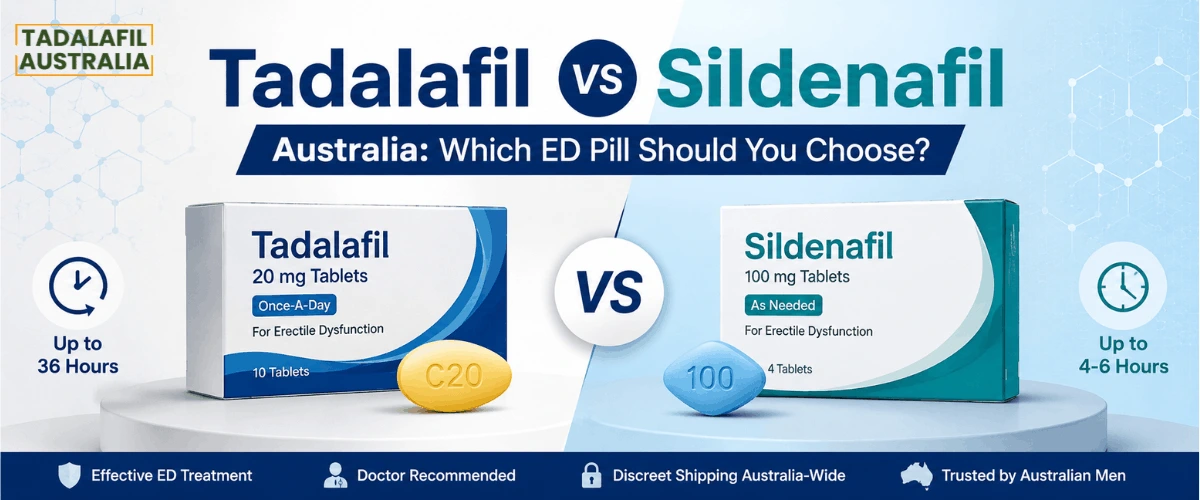
*Medical disclaimer: This article is general information only and is not a substitute for professional medical advice. Both tadalafil and sildenafil are Schedule 4 (prescription-only) medicines in Australia. Always consult a doctor or pharmacist before starting, stopping, or switching any medication.*
If you're an Australian man researching erectile dysfunction (ED) treatment, you've almost certainly come across two names again and again: sildenafil (best known by the brand name Viagra) and tadalafil (best known as Cialis). They're the two most commonly prescribed ED medications in Australia, they belong to the same drug family, and they're both backed by decades of clinical evidence.
So which one should you choose?
The honest answer is that neither pill is universally "better." They work in almost exactly the same way, but they behave very differently inside your body — and that difference is usually what tips the decision one way or the other. Sildenafil is the fast-acting, short-duration option that suits planned, occasional use. Tadalafil is the slow-burning, long-lasting option that suits men who want flexibility and spontaneity, and it's the only one of the two available as a low-dose daily tablet.
This guide breaks down everything Australian patients typically want to know before speaking to their doctor: how each medication works, how long they last, side effects, real-world costs at Australian pharmacies, prescription and telehealth rules under the TGA, and — most importantly — which type of man each pill tends to suit best.
Quick Answer: Tadalafil or Sildenafil?
Choose sildenafil if you have sex occasionally, don't mind planning ahead, and want the cheapest possible option per dose. It works within 30–60 minutes and lasts around 4–6 hours.
Choose tadalafil if you value spontaneity, are sexually active more than twice a week, or dislike the pressure of "timing" a pill. A single dose lasts up to 36 hours, and a low-dose daily version removes timing from the equation entirely.
Both medications require a prescription in Australia, both are available as affordable generics, and both are considered similarly effective in clinical studies. Head-to-head preference research consistently shows that when men try both, a majority tend to prefer tadalafil — mainly because of its longer window of effectiveness — though a significant minority prefer sildenafil for its predictability and lower cost.
Now let's dig into the detail.
Understanding Erectile Dysfunction in Australia
Erectile dysfunction — the persistent difficulty getting or keeping an erection firm enough for sex — is far more common than most men assume. Australian health surveys suggest that roughly one in five men over 40 experiences some degree of ED, and the likelihood rises steadily with age. It's not just an "older man's problem" either; stress, anxiety, alcohol, smoking, diabetes, high blood pressure, and certain medications can trigger ED at any age.
Two things are worth knowing before we compare pills:
- ED is often a health signal, not just a bedroom issue. Because erections depend on healthy blood vessels, ED can be an early warning sign of cardiovascular disease, diabetes, or low testosterone. That's one reason ED medicines are prescription-only in Australia — a proper assessment matters.
- Medication treats the symptom, not always the cause. PDE5 inhibitors like sildenafil and tadalafil are highly effective at improving erections, but your doctor may also want to address underlying issues such as blood pressure, weight, sleep apnoea, or psychological factors.
With that context in place, here's how these medications actually work.
How Sildenafil and Tadalafil Work.
Both medications belong to a drug class called PDE5 inhibitors — short for phosphodiesterase type 5 inhibitors. Despite the intimidating name, the mechanism is simple.
When you're sexually aroused, your body releases nitric oxide in the penis, which triggers a chemical called cGMP. cGMP relaxes the smooth muscle in the blood vessels of the penis, allowing blood to flow in and create an erection. An enzyme called PDE5 breaks down cGMP, which is part of how erections naturally subside.
In men with ED, this system is often out of balance — cGMP gets broken down faster than it can do its job. Sildenafil and tadalafil both block the PDE5 enzyme, allowing cGMP to accumulate, blood vessels to stay relaxed, and erections to form and last more reliably.
A critical point many first-time users misunderstand: neither pill causes an erection on its own. You still need sexual stimulation and arousal. These medicines simply make your body's natural response work properly again. If you take a tablet and sit watching television, nothing will happen — and that's by design.
Because both drugs act on the same enzyme, their effectiveness is broadly similar. What separates them is pharmacokinetics — how quickly they're absorbed, how long they stay active, and how they interact with food.
Sildenafil (Viagra) — The Original ED Medication.
Sildenafil was the world's first oral ED treatment, approved in the late 1990s, and it remains the most recognised. In Australia, it's registered with the Therapeutic Goods Administration (TGA) and sold under the original brand name Viagra as well as numerous cheaper generic brands.
Key characteristics of sildenafil
- Onset of action: Typically 30–60 minutes. Some men notice effects sooner, but an hour is a safe planning window.
- Duration: Around 4–6 hours of effectiveness.
- Standard doses in Australia: 25mg, 50mg, and 100mg tablets. Most men start on 50mg, adjusted up or down by their doctor based on response and side effects.
- Food interaction: This is sildenafil's biggest practical weakness. A heavy or fatty meal (think a pub schnitzel or a big curry) can significantly delay absorption and blunt the effect. It works best on an empty stomach or after a light meal.
- How it's taken: On demand, roughly an hour before anticipated sexual activity, no more than once per day.
Where sildenafil shines
Sildenafil is predictable. You take it, you know when it will kick in, and you know when it will wear off. For men who have sex occasionally and don't mind a bit of planning, that predictability is a feature, not a bug. It also tends to be the cheapest ED option per tablet at Australian pharmacies, because generic sildenafil has been available for years and competition has driven prices down substantially.
Where sildenafil falls short
The 4–6 hour window creates what many men describe as "performance scheduling." Intimacy has to happen inside the window, which can add pressure — and pressure is the enemy of erections. The food interaction also catches people out: taking sildenafil after a romantic dinner is one of the most common reasons a first dose "doesn't work."
Tadalafil (Cialis) — The Long-Lasting Alternative.
Tadalafil arrived a few years after sildenafil and earned the nickname "the weekend pill" for one standout reason: a single dose can remain effective for up to 36 hours. It's also TGA-registered in Australia, available as the original Cialis brand and as generic tadalafil from multiple Australian-approved manufacturers.
Key characteristics of tadalafil
- Onset of action : Usually 30–60 minutes, though some men find it takes closer to two hours to reach full effect.
- Duration : Up to 36 hours — dramatically longer than any other ED medication. This reflects tadalafil's long elimination half-life of roughly 17.5 hours, compared with about 4 hours for sildenafil.
- Standard doses in Australia : 10mg and 20mg for on-demand use; 2.5mg and 5mg for once-daily use.
- Food interaction : Minimal. Tadalafil can be taken with or without food, which makes it far more forgiving around dinner dates and social occasions.
- How it's taken : Either on demand (10–20mg before anticipated activity) or as a low daily dose (2.5–5mg every day at the same time), depending on what your doctor prescribes.
The daily dosing option — tadalafil's unique advantage
Daily low-dose tadalafil deserves its own mention because nothing else on the Australian market works this way. Instead of taking a pill "for the occasion," you take a small 2.5mg or 5mg tablet every day. After a few days, a steady level of medication builds up in your system — meaning you're effectively "ready" at any time, with no timing, no planning, and no pill-taking ritual attached to sex at all.
For men in relationships, men who are sexually active twice a week or more, or men for whom the act of taking a pill before sex creates anxiety, daily tadalafil can be genuinely life-changing. As a bonus, tadalafil is also approved for treating symptoms of benign prostatic hyperplasia (BPH, or enlarged prostate), so men dealing with both conditions can sometimes address the two with a single daily medication — something to discuss with your GP.
Where tadalafil falls short
The extended duration cuts both ways: if you experience side effects, they can also linger longer. Muscle aches and back pain — side effects somewhat more associated with tadalafil than sildenafil — occasionally persist for a day or so. On-demand tadalafil has also historically cost slightly more per tablet than generic sildenafil, although generic competition has narrowed that gap considerably.
Tadalafil vs Sildenafil: Head-to-Head Comparison.
|
Feature |
Sildenafil (Viagra) |
Tadalafil (Cialis) |
|
Drug class |
PDE5 inhibitor |
PDE5 inhibitor |
|
Onset of action |
30–60 minutes |
30–120 minutes |
|
Duration of effect |
4–6 hours |
Up to 36 hours |
|
Half-life |
~4 hours |
~17.5 hours |
|
Common doses (AU) |
25mg, 50mg, 100mg |
10mg, 20mg (on demand); 2.5mg, 5mg (daily) |
|
Daily dosing option |
No |
Yes |
|
Food interaction |
Significant (fatty meals delay effect) |
Minimal |
|
Alcohol |
Small amounts OK; excess impairs both |
Small amounts OK; excess impairs both |
|
Typical cost per tablet (generic, AU) |
Often the cheapest ED option |
Slightly higher on demand; daily packs competitive |
|
Prescription required in Australia |
Yes — Schedule 4 |
Yes — Schedule 4 |
|
Also treats BPH symptoms |
No |
Yes (daily dosing) |
|
Best suited for |
Planned, occasional use; budget-conscious users |
Spontaneity; frequent activity; men who dislike timing pills |
Effectiveness: is one stronger than the other?
In clinical trials, both medications improve erections in roughly 60–80% of men with ED, depending on the underlying cause and dose. Neither drug is meaningfully "stronger" at equivalent therapeutic doses. What differs is the *experience* of using them.
Preference studies — where men try both drugs and then choose — repeatedly find that a majority lean toward tadalafil, with the extended duration and reduced time pressure cited as the main reasons. But preference isn't the same as superiority. Plenty of men prefer sildenafil precisely because it's out of their system quickly, they only need it occasionally, or they've simply found it works well for them at a lower price. Some men also respond better to one drug than the other for reasons that aren't fully predictable — which is why doctors sometimes suggest trialling both before settling.
Side effects compared
Because both drugs relax blood vessels throughout the body (not just where you want them to), they share a similar side effect profile:
Common to both: headache, facial flushing, nasal congestion, indigestion, and dizziness. These are usually mild and fade as the medication wears off.
More associated with sildenafil: visual disturbances — a temporary bluish tint to vision or increased light sensitivity. This is uncommon and short-lived but distinctive to sildenafil.
More associated with tadalafil: back pain and muscle aches, typically appearing 12–24 hours after dosing and resolving within a couple of days.
Rare but serious (both drugs): priapism (a painful erection lasting more than four hours — a medical emergency requiring immediate hospital attention), sudden hearing loss, and sudden vision loss. These are rare, but every man taking a PDE5 inhibitor should know that a four-hour erection means going straight to an emergency department, not waiting it out.
The one interaction everyone must know: nitrates
This applies equally to both medications and it is non-negotiable. Never combine sildenafil or tadalafil with nitrate medicines — such as glyceryl trinitrate (GTN) sprays or patches used for angina, or isosorbide tablets. The combination can cause a sudden, dangerous drop in blood pressure. The same warning applies to recreational "poppers" (amyl nitrite). Men taking alpha-blockers for prostate or blood pressure issues also need careful medical guidance, as do those with significant heart disease, recent stroke or heart attack, severe liver or kidney impairment, or certain rare eye conditions. This is exactly why an honest conversation with a prescriber matters more than which pill you pick.
Which Should You Choose? Matching the Pill to Your Lifestyle
Rather than asking "which drug is better," Australian doctors generally frame the decision around lifestyle. Here's how that plays out in practice.
Sildenafil tends to suit you if:
- Your sexual activity is occasional and usually planned.
- You're comfortable taking a tablet about an hour beforehand.
- You want the lowest cost per dose.
- You prefer a medication that clears your system the same day.
- You've used it before and it works well for you.
Tadalafil tends to suit you if:
- You value spontaneity and dislike "scheduling" intimacy.
- You're sexually active two or more times per week (daily dosing often becomes both more convenient *and* more economical here).
- Dinner dates are part of your routine — the lack of food interaction is a real advantage.
- Performance anxiety is part of your ED picture, and separating pill-taking from sex would help psychologically.
- You also have symptoms of an enlarged prostate.
A note on switching and trialling
It's common — and completely reasonable — to trial one medication, review how it went with your doctor, and switch if it's not the right fit. Dose adjustments solve many "it didn't work" experiences: a man who gets no result from 50mg sildenafil on a full stomach may do perfectly well with 100mg on an empty one, or may simply feel less pressured on tadalafil. Give any medication a fair trial of several attempts before writing it off, since anxiety on the first occasion skews results for many men.
What Do Tadalafil and Sildenafil Cost in Australia?
Exact prices vary between pharmacies, brands, dose strengths, and pack sizes, so treat the following as a general guide rather than a quote — and note that ED medications are generally not subsidised under the PBS for erectile dysfunction, meaning you'll pay the private price.
- Generic sildenafil is usually the cheapest option, often working out to just a few dollars per tablet when bought in standard packs from discount pharmacies. Branded Viagra costs considerably more for the identical active ingredient.
- Generic tadalafil (on demand) typically costs a little more per tablet than sildenafil, though prices have fallen sharply since multiple generics entered the market.
- Daily tadalafil (2.5–5mg) is priced per month rather than per event. For men having sex frequently, the monthly cost of daily dosing can compare favourably with buying multiple on-demand tablets.
- Telehealth consultation fees vary by provider; some bulk-bill, others charge a modest consult or script-renewal fee.
Money-saving tips that Australian pharmacists themselves suggest: always ask for the generic, compare a couple of pharmacies (prices genuinely differ), and ask your doctor whether a higher-strength tablet split in half is appropriate for your prescribed dose — a common, doctor-approved way to reduce cost per dose for some tablet formulations.
Beyond the Pill: What Else Helps ED?
Whichever medication you and your doctor choose, results improve when you address the fundamentals. PDE5 inhibitors work with your blood vessels — so anything that improves vascular health improves your response to the medication:
- Exercise — even brisk walking several times a week measurably improves erectile function.
- Reducing alcohol— a couple of drinks is fine; heavy drinking sabotages both pills.
- Quitting smoking — one of the single biggest modifiable causes of ED.
- Managing weight, blood pressure, cholesterol, and blood sugar.
- Sleep — untreated sleep apnoea is strongly linked to ED.
- Mental health — anxiety, depression, and relationship stress are major contributors, and psychological support or sex therapy helps many men, sometimes alongside medication and sometimes instead of it.
Some men find that after months of successful medication use, confidence returns and they need the tablets less often. ED treatment isn't necessarily forever.
Frequently Asked Questions
Neither is objectively better — they're similarly effective at improving erections. Tadalafil lasts far longer (up to 36 hours vs 4–6 hours) and isn't affected by food, which many men prefer. Sildenafil is typically cheaper and clears the body faster. The right choice depends on your lifestyle, frequency of sexual activity, budget, and how you respond individually.
No. Both are Schedule 4 prescription-only medicines in Australia. You need a valid prescription from an Australian-registered doctor, obtained via a GP visit or a legitimate telehealth consultation. Websites offering these medicines without a prescription are illegal and frequently sell counterfeit products.
Tadalafil remains effective for up to 36 hours after a single dose, thanks to its long half-life of around 17.5 hours. Sildenafil lasts roughly 4–6 hours. This is the single biggest practical difference between the two medications.
No. Combining two PDE5 inhibitors increases the risk of serious side effects, including dangerous drops in blood pressure, without improving results. Take only one ED medication at a time, exactly as prescribed.
Yes — but very differently. A heavy or fatty meal can significantly delay and weaken sildenafil, so it's best taken on an empty stomach. Tadalafil is largely unaffected by food, making it more flexible around meals.
One or two standard drinks is generally considered acceptable with either medication, but heavier drinking both increases the risk of side effects like dizziness and directly impairs erections — working against the very thing you're trying to fix.
Don't panic, and don't assume the medication has failed. Common culprits include taking sildenafil after a big meal, insufficient sexual stimulation, first-time anxiety, or a starting dose that's too low. Doctors generally recommend trying a medication on several separate occasions before judging it. If it's still not working, your doctor can adjust the dose or switch you to the other medication.
Men taking nitrate medications (for angina) or nicorandil must never take sildenafil or tadalafil. Caution or avoidance also applies to men with recent heart attack or stroke, unstable angina, severe heart failure, very low blood pressure, severe liver or kidney disease, or certain inherited eye conditions. This is precisely why a medical assessment is required — the screening protects you.
Low-dose daily tadalafil (2.5–5mg) is TGA-approved and widely prescribed for ongoing use. Like any long-term medication, it should be reviewed periodically by your doctor, particularly if your health or other medications change.
Yes. TGA-approved generics must demonstrate bioequivalence to the original brand — the same active ingredient, absorbed the same way, producing the same effect. The dramatic price difference reflects patent expiry and market competition, not quality.
Please log in to add a comment.


Dr. John
a retired General Physician with 45+ years of clinical experience. He specializes in sleep disorders, chronic pain management, and medication safety, and helps ensure our medical articles are accurate, safe, and easy for patients to understand.
Comments........!